

Blog
Building Retrofitting Explained: The Seismic Strengthening Process Step by Step
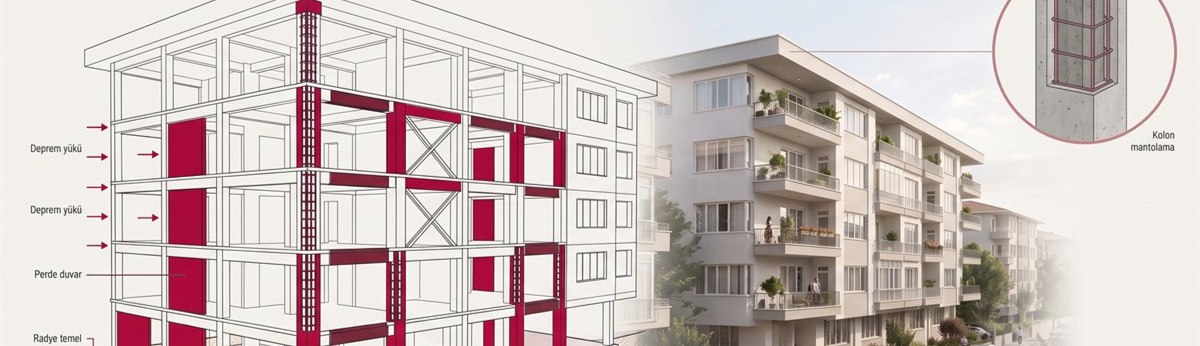
Seismic retrofitting is the engineering work that upgrades the load-bearing system of an existing building to the performance level required by current codes, without demolishing and rebuilding it. Many buildings in earthquake-prone regions were designed before modern seismic codes came into force. That is why owners of homes, factories, hotels, shopping malls and schools increasingly ask the same question: “Is my building safe, and can it be strengthened?”
This article walks you through the structural strengthening process, from the first survey to the works on site.
Which Buildings Need Retrofitting?
Not every old building needs strengthening, and not every new building is automatically safe. A seismic performance assessment is the right first step if any of the following applies:
- The building was designed or built before the current seismic code in your country,
- Its use has changed (for example, a residential building converted into offices, a hotel or a warehouse),
- Unplanned alterations were made, such as added storeys or cut columns and walls,
- Columns and beams show corroded reinforcement, spalling concrete or visible cracks,
- The building was damaged in a previous earthquake,
- It is a facility that must stay operational after an earthquake: a hospital, school, factory or power plant.
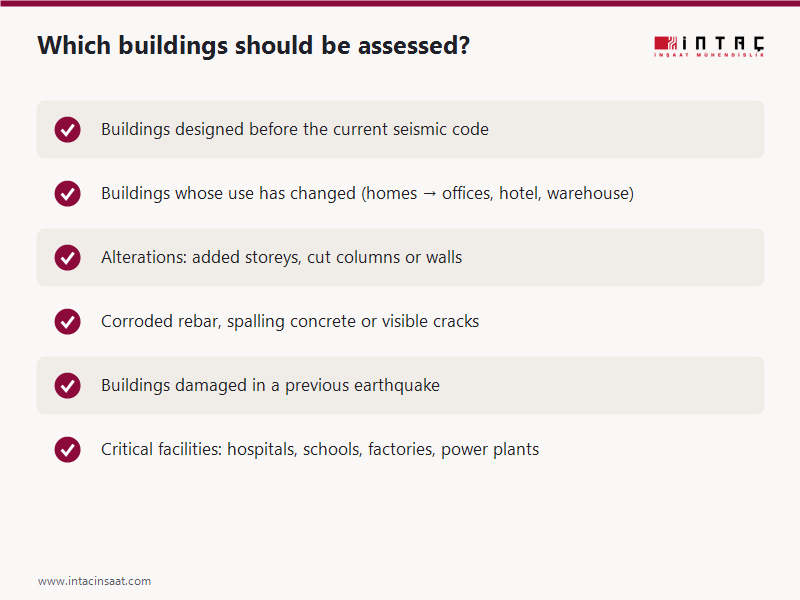
If any of these applies, the building’s seismic performance should be assessed.
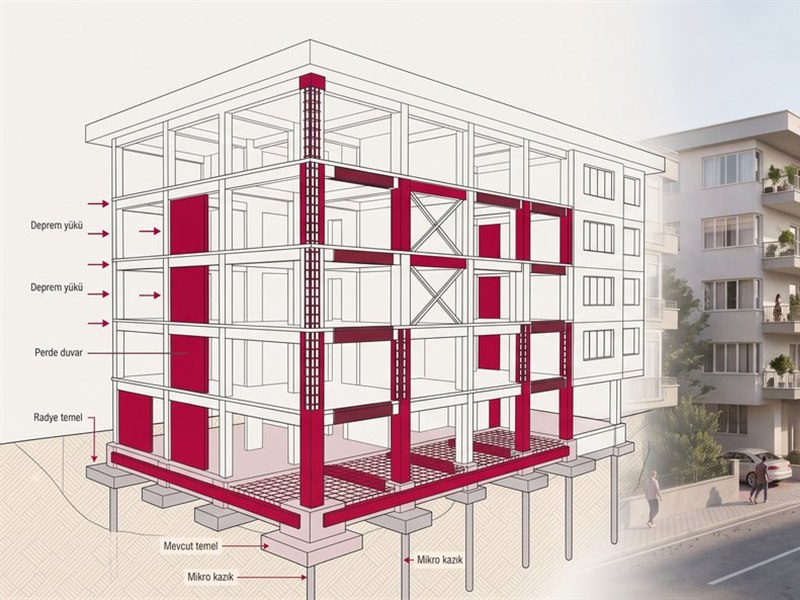
Typical elements of a retrofit project: new shear walls, column jacketing, a raft foundation and micropiles. (Illustration)
The Retrofitting Process in 6 Steps
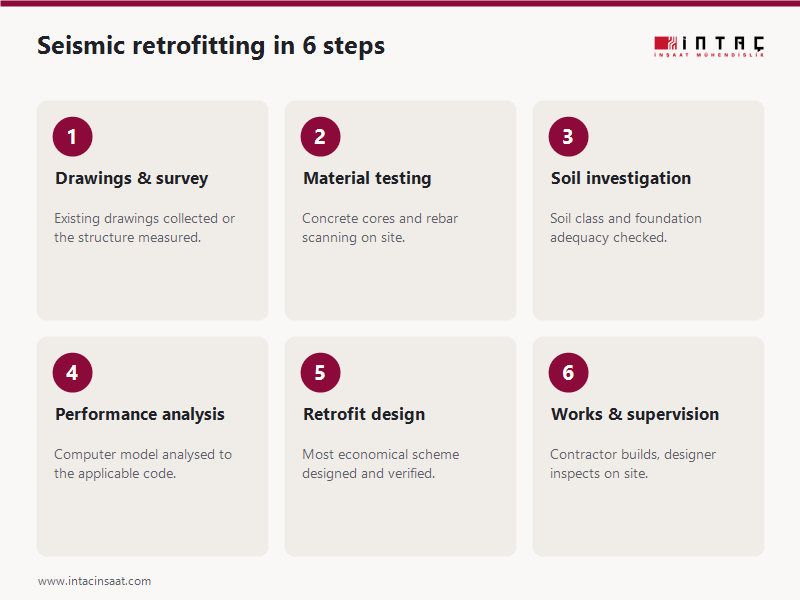
The retrofitting process: six steps from survey to site works.
1. Collecting existing drawings and surveying the structure
Architectural and structural drawings are obtained from the owner or the local authority. If they are missing, or the building was not built as designed, columns, beams, walls and slabs are measured on site to produce a structural survey.
2. On-site investigation and material testing
Concrete cores are extracted from structural members and tested in the laboratory to determine concrete strength. Rebar scanners are used to detect bar sizes, numbers and stirrup spacing, and the cover is removed at selected points to check corrosion. The amount of data collected defines the “knowledge level” of the assessment and therefore how reliable the analysis is.
3. Geotechnical investigation
Soil conditions directly affect the earthquake loads acting on a building. Where needed, boreholes and geophysical tests are carried out to classify the soil and check whether the existing foundations are adequate.
4. Seismic performance analysis
A computer model of the building is created and analysed with linear or non-linear methods according to the applicable code — the Turkish Building Earthquake Code (TBDY 2018) in Türkiye, or international standards such as Eurocode 8-3 and ASCE 41 elsewhere. The result shows whether the building meets its target performance level, from immediate occupancy to collapse prevention. Read more in Calculation Methods of Earthquake Performance Analysis.
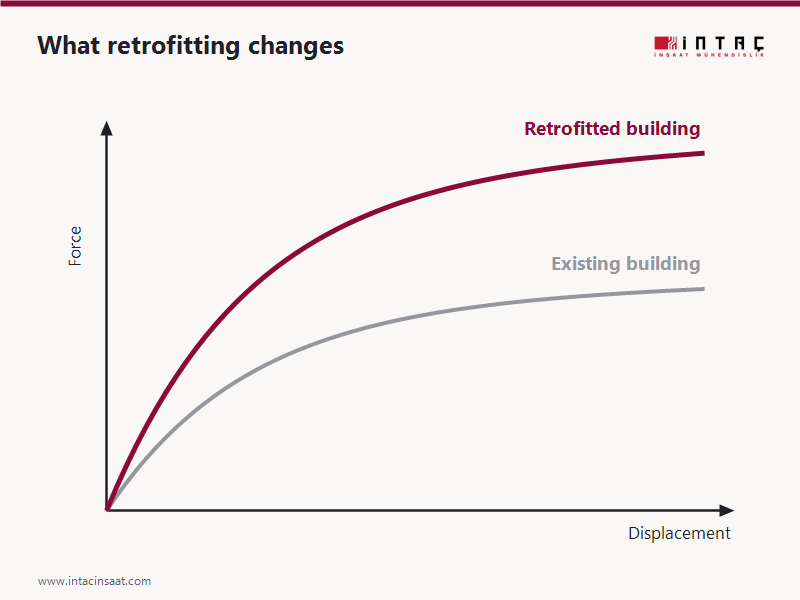
Retrofitting raises the lateral force the building can resist. (Indicative curve)
5. Designing the retrofit
If the building falls short of the target, engineers design the most economical and buildable strengthening scheme and re-analyse the strengthened structure to confirm that it performs as required. The right solution depends on the structural system, the use of the building and the budget.
6. Construction and site supervision
The retrofit is carried out by a qualified contractor. Regular site checks by the design office are essential to make sure every detail is built as designed.
The Most Common Retrofitting Methods
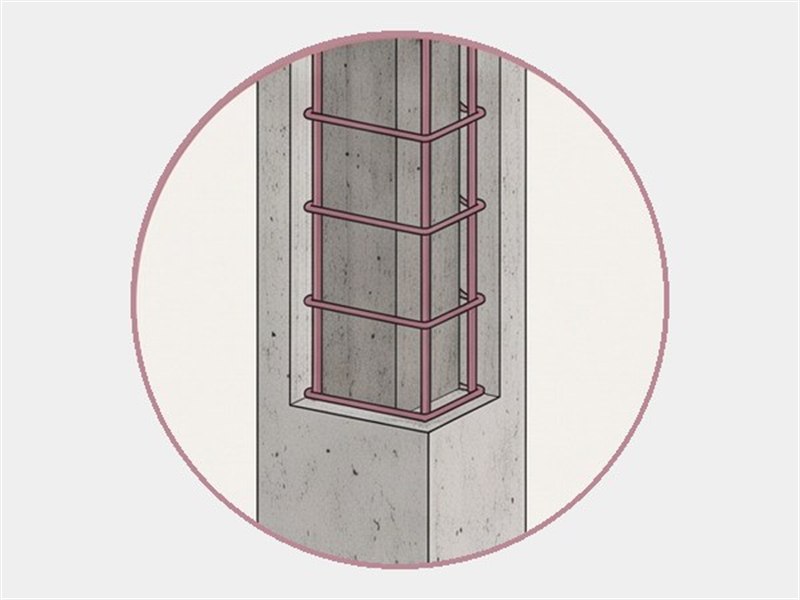
Column jacketing: new reinforcement and concrete are added around an existing column to enlarge its section and increase its capacity.
- New reinforced concrete shear walls: the most effective way to increase lateral stiffness and strength, and the first choice for many residential and office buildings.
- Column jacketing: weak columns are wrapped with new reinforcement and concrete to enlarge their sections.
- Steel jacketing and steel bracing: fast to install and light, widely used in industrial facilities and buildings that must stay in use.
- Fibre-reinforced polymer (FRP) wrapping: increases the shear and confinement capacity of columns and beams without enlarging them.
- Foundation strengthening and micropiles: foundations are enlarged or supported with a raft and micropiles to carry the loads of new shear walls to the ground.
We will compare these methods in more detail in an upcoming article.
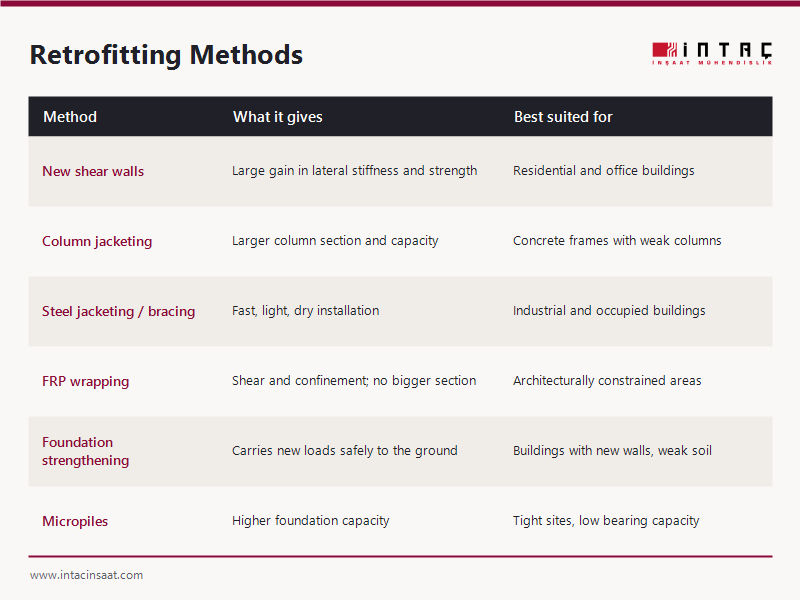
Retrofitting methods and where each one fits best.
Retrofit or Rebuild?
In most cases retrofitting is faster and cheaper than demolition and reconstruction, and it can allow the building to stay in use. However, if concrete strength is very low, corrosion is advanced or the required intervention is very extensive, rebuilding may make more sense. A reliable performance assessment is needed before making this decision.
Seismic Retrofitting with İNTAÇ
Since 2004, İNTAÇ has delivered engineering projects in 30 countries, including seismic assessments and strengthening designs for residential buildings, hotels, thermal power plants and port structures. Explore our strengthening projects.

An İNTAÇ project: Levent Hotel retrofit, Istanbul — structural model (left) and completed building (right).
Want to know how your building would perform in an earthquake? Contact our engineers.
Frequently Asked Questions
How long does seismic retrofitting take?
Survey, testing, analysis and design usually take a few weeks, depending on the size of the building. Construction time depends on the chosen method and on whether the building stays in use.
Do occupants need to leave the building during retrofitting?
Not always. With methods such as steel elements or FRP and a phased work programme, many buildings can be strengthened while partly in use. This should be planned at the very start of the project.
Can İNTAÇ work on projects outside Türkiye?
Yes. İNTAÇ has delivered projects in 30 countries and works with both the Turkish code and international standards such as the Eurocodes.
Latest Blog
-

-

Silo Static Project
29 July 2024 -

-

Methods Used In Earthquake Performance Analysis
4 July 2024 -

Reinforced Concrete Calculation Static Report
31 January 2024 -

Steel Calculation Static Report
31 January 2024 -
What Is CFD Analysis?
22 December 2023 -

What Are The Benefits Of CFD Analysis?
22 December 2023 -
Silo Reinforcement with Post-Tensioning Method
26 September 2023 -
Post Tensioning Method in Cantilever Slabs
4 September 2023 -
Post-Tensioning Application In Reinforced Concrete Silos
22 August 2023 -
Components Of Post Tensining
16 August 2023 -
What Are Pre-Stressing And Post-Tensioning?
11 August 2023 -
What is Prestressing?
8 August 2023 -

History Of Post Tensioning
8 July 2023